Building the right restaurant tech stack is one of the most important decisions an African restaurant owner can make today. And yet, most are making it with tools that were never designed for this market.
There is a question that does not get asked often enough in conversations about African hospitality: built for whom?
Every time a restaurant owner in Lagos or Nairobi signs up for a global reservation platform, a point-of-sale system from North America, or a CRM tool built in Europe, they are making a quiet assumption. That the people who built that tool had their restaurant in mind when they built it. That the problems it solves are the same problems showing up at their host stand every weekend. That the infrastructure underneath it works the same way here as it does in the cities where those tools were designed.
Most of the time, none of that is true.
This is not a criticism of global restaurant technology companies. They build for their markets, and they build well for those markets. The problem is that African restaurants keep trying to fit their operations into tools that were never shaped around them, and then wondering why the results are underwhelming.
The restaurant tech stack conversation in Africa needs to start from a completely different place.
Before getting into why Africa needs its own, it helps to be clear about what a restaurant tech stack means in practical terms.
A restaurant tech stack is the collection of tools and systems a restaurant uses to run its operations, attract guests, manage bookings, process payments, communicate with customers, and understand how the business is performing. In a well-built stack, these tools talk to each other. Data flows between them. A booking made online updates the table management system. A guest who visits three times gets flagged in the CRM. A payment processed at the table feeds into the revenue dashboard.
In a poorly built stack, or one assembled from mismatched global tools, none of that happens cleanly. The booking system does not connect to the CRM. The payment processor does not talk to the reservation tool. The owner ends up manually moving information between systems that were never designed to work together, which defeats the entire purpose of having technology in the first place.
Industry research consistently shows that restaurants lose between 20 and 30 percent of potential revenue through fragmented systems that cannot share data across business units, with teams spending hours on manual reconciliation and duplicate data entry instead of focusing on the guest experience.
For African restaurants dealing with this problem, the solution is not to find better global tools. It is to build or adopt a stack designed around the specific realities of operating here.
A restaurant owner in London building a tech stack has certain assumptions baked into every tool they consider. Reliable internet connectivity. Guests who book primarily through desktop or mobile web browsers. Email as a primary communication channel. A card payment infrastructure that works seamlessly across every transaction. Credit card details that can be stored securely for deposit purposes without friction.
None of those assumptions hold consistently in the African context, and the gaps they create are not small.
Take connectivity. Many parts of Lagos, Nairobi, Abuja, and Accra experience inconsistent internet access. A reservation system that requires a constant stable connection to function is not a reliable system for a restaurant in these cities. It is a liability. A kitchen display system that goes down every time the network drops is not an operational tool. It is a source of stress during the busiest part of service.
Take communication. Over 70 percent of diners globally check a restaurant's website before visiting, and nearly 60 percent prefer to order directly from a restaurant's website when the experience is good. That behaviour exists in Africa too. But the channel where decisions actually get made, where reservations get confirmed, where promotions get read and acted on, is WhatsApp. A global CRM tool that prioritises email sequences over WhatsApp messaging is optimised for a communication habit that most African restaurant guests simply do not have.
Take payments. Deposit-based reservation systems, which are one of the most effective tools for reducing no-shows in the Nigerian market, require a payment infrastructure that works smoothly on mobile, accepts local payment methods, and processes transactions without the friction that comes from systems built around international card rails. Many global reservation platforms either do not support this at all or require workarounds so complicated that most operators give up and go back to WhatsApp.
These are not edge cases. They are the everyday operational reality of running a restaurant in Africa, and every global tool that does not account for them creates friction that costs restaurants money.
The starting point is not features. It is fit.
A restaurant tech stack built for Africa needs to work reliably in low-connectivity environments. It needs to be operable primarily from a mobile phone, because that is the device most restaurant owners and managers in this market use to run their business day to day. It needs WhatsApp as a first-class communication channel, not an afterthought integration bolted onto an email marketing tool. And it needs a payment infrastructure that supports local payment methods, deposit collection, and the kind of seamless mobile transaction that African guests expect.
Beyond the infrastructure layer, the stack needs to solve the specific growth problems African restaurants face. Discovery is one. A restaurant's website is no longer just a brochure. It is the front door to a direct ordering channel, the home of guest data capture, and the primary vehicle for local SEO presence. Most African restaurants either do not have a website or have one that does not function well enough to convert a visitor into a booking. That is a discovery problem and a conversion problem sitting in the same place.
Guest retention is another. The tools that help a restaurant understand which guests are at risk of churning, which regulars have not been back in six weeks, and which first-time visitors never returned, are the tools that turn a busy Saturday into a consistently full week. Global CRM tools exist for this purpose, but they are built around guest behaviour patterns that do not always translate to how people dine in Lagos or Nairobi.
The ideal African restaurant tech stack addresses all of this from a single connected system. Not five separate tools that require manual integration. Not a global platform with an Africa checkbox in the settings. A system built from the ground up around the specific shape of this market.
In markets with mature restaurant technology ecosystems, operators can afford to assemble a stack from best-in-class individual tools because the integration infrastructure exists to connect them. APIs are well documented. Third-party integrations are reliable. The tools are built to talk to each other.
In most African markets, that infrastructure does not yet exist at scale. Connecting a reservation tool from one provider to a CRM from another to a payment processor from a third is a technical project that most independent restaurant operators simply cannot execute or maintain. It requires developer resources, ongoing maintenance, and a level of technical sophistication that should not be a prerequisite for running a good restaurant.
This is why the all-in-one approach is not just convenient for African restaurants. It is necessary. A single platform that handles discovery, bookings, payments, guest data, and communication removes the integration problem entirely. Everything talks to everything because it was built that way from the start.
The most forward-thinking operators globally are already moving away from fragmented tool collections toward unified platforms that connect front-of-house, back-of-house, and customer data in a single system. African restaurants do not need to go through the fragmentation phase first. They can go straight to what works.
There is something else worth saying directly. A restaurant tech stack built locally, by a team that understands African hospitality from the inside, carries advantages that no global platform can replicate through localisation efforts.
Understanding that a restaurant in Lagos deals with power outages that require the system to keep working offline. Knowing that a reservation confirmation sent at 9pm on a Wednesday in Lagos needs to land on WhatsApp, not in an email inbox that might not get checked until Monday. Recognising that the deposit amounts that work to reduce no-shows in the Nigerian market are different from what works in London, and that the psychology behind them is shaped by how Nigerians relate to financial commitments.
These are not details that can be configured in a settings panel. They are insights that come from operating in the market, building for the market, and caring about the outcomes of the restaurants in the market.
That is the foundation a genuinely African restaurant tech stack is built on. And it is what separates a tool that works here from one that merely works.
A restaurant running on the right tech stack does not just operate more efficiently. It competes differently. It can be found by guests who have never heard of it before. It converts those guests into confirmed bookings rather than losing them to friction. It remembers them after they leave, brings them back before they forget, and builds the kind of loyal customer base that makes a restaurant recession-proof.
None of that is available to a restaurant patching together global tools that were never built for this market.
The African restaurant industry is at a point where the infrastructure is finally catching up to the ambition. The operators who build their tech stack on tools designed for how this market actually works are the ones who will look back in five years and understand exactly why they grew when others did not.
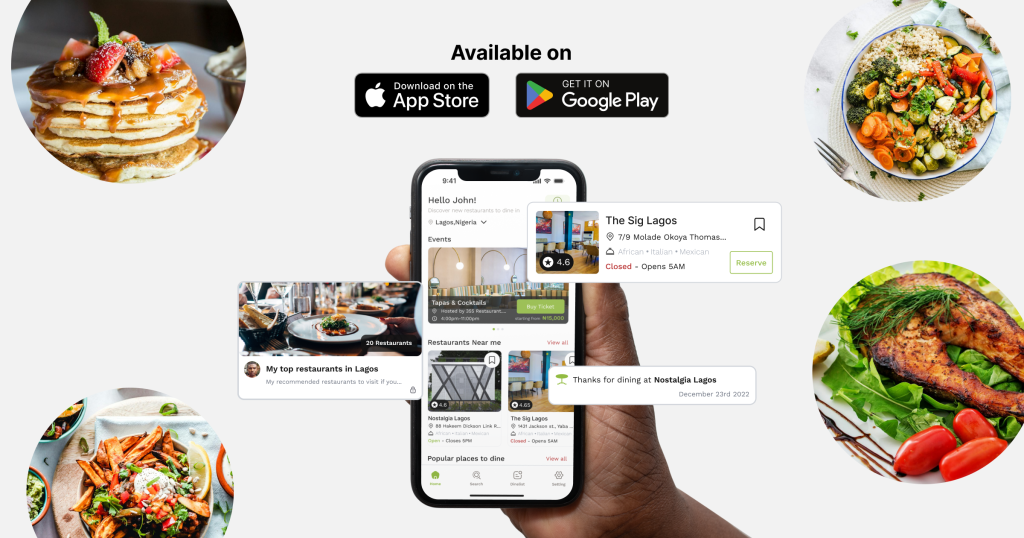
Want to see what a restaurant tech stack built for Africa looks like in practice? Explore how Dinesurf helps African restaurants attract guests, convert bookings, and retain customers from one connected system at dinesurf.com
Dinesurf is the Guest Growth OS for hospitality brands across Africa.
We help restaurants, lounges, nightlife venues, and experience-led operators attract the right guests, convert demand into paid bookings, and turn first-time visits into repeat revenue, all from one connected system.
We are not just another restaurant software. We are the commercial growth layer built specifically for African hospitality priced for this market, backed by a local team, and invested in the growth of the continent's dining culture.