There is a restaurant in Lagos that serves the best pepper soup you will ever taste in your life. The kind that clears your sinuses, warms your chest, and makes you forget whatever was bothering you before you sat down. The owner has been running it for eleven years. His regulars swear by it. And yet, if you search for it online, you will find nothing. No website. No updated Google listing. A Facebook page last touched in 2021.
That restaurant exists in a city of over 20 million people. And most of those people will never find it.
This is not a story about one restaurant. It is the story of thousands of them, scattered across Lagos, Abuja, Nairobi, Kigali, Accra, and every major African city where food culture is rich, dining scenes are growing, and the infrastructure to connect hungry people to great restaurants simply has not kept up.
The restaurant booking problem in Lagos and across Africa nobody talks about enough
Ask anyone who lives in an African city and they will tell you the same thing. Finding a restaurant, a good one that fits the mood you are in, the budget you have, and the occasion you are planning for, is harder than it should be.
You ask a friend. They send you a WhatsApp message with a name and an address, but no phone number. You search online and find a listing with no photos, wrong opening hours, and reviews from 2019. You call the number on Instagram and it rings out. You show up anyway and the kitchen is closed for a private event.
This is the discovery gap. It is the friction that sits between a diner who wants to eat out and a restaurant that wants to be found. And it costs everyone.
For diners, it means settling. Defaulting to the same three places because at least you know what to expect. Skipping the adventure of trying something new because the research is too exhausting.
For restaurant owners, it means empty tables on a Tuesday night even though the weekend was fully booked. It means spending money on Instagram ads that reach people who are already aware of you. It means watching potential customers walk past your door because they had no idea you existed.
The market is there. The appetite, literally and figuratively, is there. What has been missing is the connective tissue.
Why fixing restaurant discovery in Africa has been so hard
It would be easy to say that African restaurants just need better websites and more consistent social media. But that diagnosis misses the actual complexity.
Most restaurant owners on this continent are not sitting on resources they are failing to deploy. They are running tight operations, often with small teams, dealing with supply chain unpredictability, managing staff turnover, navigating rising food costs, and somehow still trying to put out good food every single service. Building and maintaining a polished digital presence is simply not where their time goes.
And the tools that exist globally were not built with them in mind. Platforms like OpenTable and SevenRooms were designed for markets where reliable internet, card payments, and a culture of advance reservations were already the norm. Plugging those tools into the Lagos or Nairobi context has always been a square peg, round hole situation. The pricing models do not fit. The support is remote. The features assume a customer behaviour that does not yet exist here, or exists differently.
What African restaurants needed was not a translation of a Western product. They needed something built from scratch, with an understanding of how dining actually works in this part of the world.
What Dinesurf is doing differently
Dinesurf started from a simple observation: the dining experience in Africa deserved better infrastructure. Not borrowed infrastructure. Not adapted infrastructure. Something purpose-built.
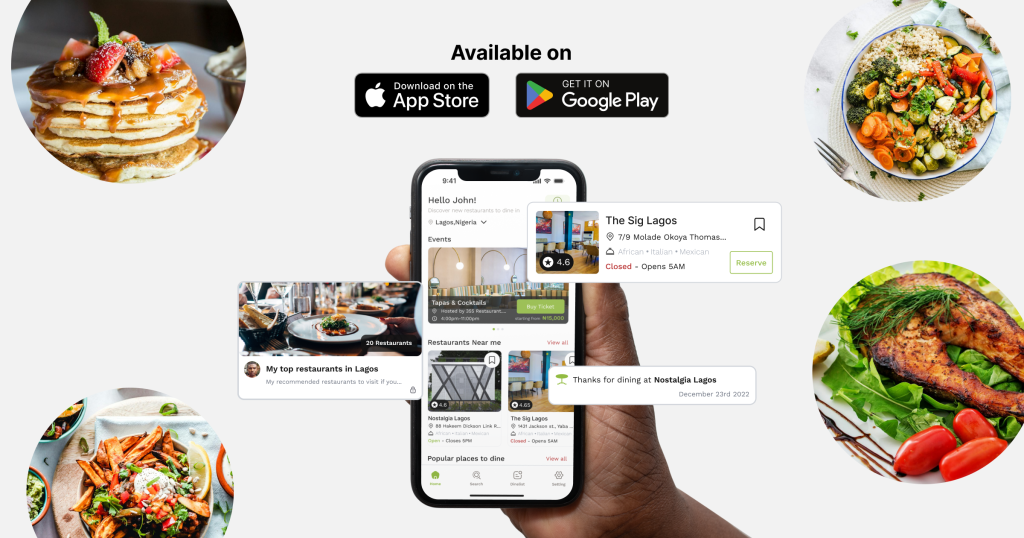
The platform works on two sides simultaneously. For diners, it is a fast and genuinely useful way to discover restaurants across Africa, read real information, see actual menus, and make a reservation in under 90 seconds. No friction, no dead ends, no calling a number that no one picks up.
For restaurant owners, it is something closer to a full operating system for their guest relationships. Dinesurf gives restaurants a professional, searchable online presence that stays current. It handles reservations automatically and sends instant confirmations via WhatsApp and SMS, the channels their customers actually use. It collects guest data in a structured way so that owners finally know who their regulars are, when their peak periods fall, and what their customers prefer.
That last part matters more than it might sound. One of the most consistent problems in African restaurant management is that guest knowledge lives in people's heads, not in systems. A waiter knows that table seven always orders the grilled fish. A manager knows that a particular guest always comes in on Fridays with a group of eight. When that waiter leaves, or that manager moves on, the knowledge leaves with them. Dinesurf captures it, organises it, and makes it actionable.
Restaurants using the platform have access to targeted messaging tools, so they can reach specific guests with the right communication at the right time. A customer who came in three months ago and has not returned gets a personalised note. A regular who always books for special occasions gets an early heads up before Valentine's Day or Christmas. These are not mass blasts. They are the kind of considered, personalised outreach that turns one-time visitors into loyal guests.
Restaurant booking in Lagos: the numbers behind Dinesurf's growth
The growth Dinesurf has seen is not the gradual kind. It is the kind that happens when a solution genuinely fits the problem it is trying to solve.
The platform is now active across Nigeria, Rwanda, Kenya, South Africa, and the United States, funnelling between 15,000 and 20,000 diners every month to partner restaurants. Revenue processed through the platform went from N600,000 a month to N4 million in a single day. These are not projections or targets. They are what happened when the right infrastructure met a market that was ready for it.
Restaurants that might have spent years invisible to anyone outside their immediate neighbourhood now have a live, SEO-optimised profile that puts them in front of diners actively searching for somewhere to eat. The digital presence that used to require a web developer, a social media manager, and a booking system running in parallel now comes as one integrated package.
The restaurants that are thriving on Dinesurf
The restaurants seeing the biggest results on Dinesurf are not necessarily the most famous ones. They are the ones that showed up fully: complete profiles, updated menus, responsive to guest feedback, and consistent in how they engage with their audience through the platform.
What Dinesurf has made clear is that discoverability is not just about being listed somewhere. It is about being listed in a way that builds trust with a diner who has never visited you before. A complete, well-presented profile with real photos and accurate information does more work than any single Instagram post.
The platform also levels the playing field in a meaningful way. A well-run neighbourhood restaurant with a compelling profile can sit alongside a high-end establishment in search results. What determines visibility is relevance and quality, not marketing budget.
Why now is the right time
The African dining scene is at an inflection point. Middle-class populations are expanding across the continent. Urbanisation is accelerating. Dining out, whether for celebration, business, or simply the pleasure of a good meal, is becoming a more regular part of life for more people.
The infrastructure that supports that behaviour needs to catch up. Diners want to explore. They want to try new places, book ahead, and arrive knowing what to expect. Restaurant owners want to fill their tables, understand their guests, and build something that lasts beyond word of mouth alone.
The gap between what diners want and what restaurants can currently offer is closing. Dinesurf is a significant part of how that is happening.
About Dinesurf
Dinesurf is the Guest Growth OS for hospitality brands across Africa.
We help restaurants, lounges, nightlife venues, and experience-led operators attract the right guests, convert demand into paid bookings, and turn first-time visits into repeat revenue — all from one connected system.
We are not just another restaurant software. We are the commercial growth layer built specifically for African hospitality — priced for this market, backed by a local team, and invested in the growth of the continent's dining culture.